Category: agentic

  • The New Open Source Playbook – Products and Customers in an Agentic Engineering World

    Thus far in this series, I’ve focused on various ways to align with ecosystems and communities and create or integrate with platforms. This is designed to maximize the engineering economics of your business, reducing costs, outsourcing maintenance, and benefiting from innovation that comes from outside your employer or core engineering team. But if you’re running a business, you’re probably asking, “that’s great, but how do I make money?” In the past, my snarky answer was, “create a great product that reduces your customers’ pain and saves them time. Duh…” But as time goes on, I’ve realized that what they’re really asking is how to benefit from open source innovation without giving away your core value for free. That is to say, how do you do this open source stuff and still create a moat that prevents competitors from stealing your milkshake while you establish lucrative business relationships with your customers and partners?

    Open Source Heirarchy of Products
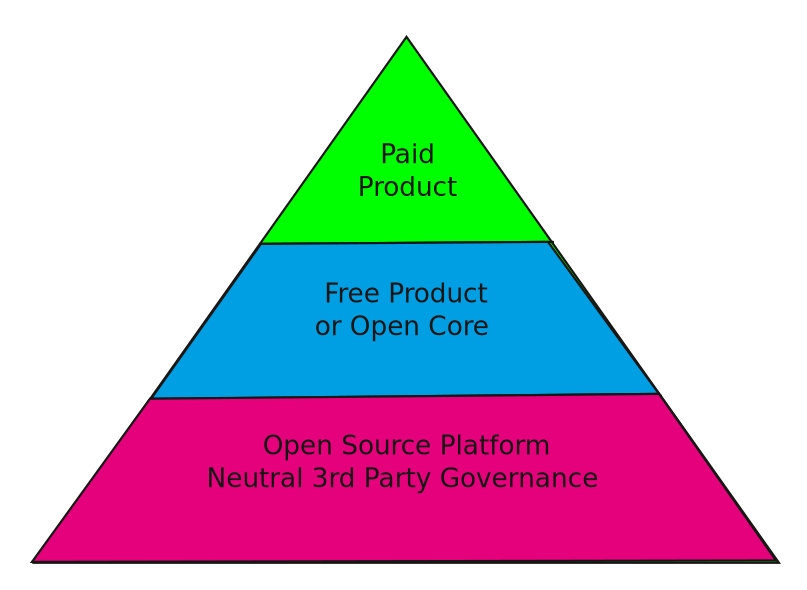
    Triangle with 3 layers. At the top is "paid product". The middle layer is "Free Product or Open Core". And the bottom layer is "Open Source Platform Neutral 3rd Party Governance".

    Thus far in this series, I’ve focused on the lower parts of the above pyramid. In this post, I’m going to focus on the upper parts. The lower 3rd, which focuses on platforms, is about cost, the bottom line, and generating enough innovation that provides lift to the 2 upper layers. Platforms are about engineering economics – how do I accelerate innovation for less money than I would spend if I did it all myself. It’s about delegation, ecosystem integration, neutral 3rd parties, and open governance. The 2 upper layers about about taking the platform innovation and applying it to customer use cases; going to market and showing product-market fit. The bottom layer is a shared resource. The top layers are all yours. Even then, there’s an art to constructing your products to give you the best chance to thrive. You’ll notice that I break this section into 2 layers and not one. Even when the product is 100% yours, there’s a need to diversify your customer base and think about the multiple personas you want to bring into your fold.

    The “Freemium” or Open Core Layer

    No product category has been as poorly understood as open core or other “free to use” products. In the early to mid 2000s, there was a simple model for getting investors to put money into a startup: take an established open source project and “commercialize” it, stripping it of just enough features so that you could convince users to convert into paying customers in order to get the “creamy frosting” of paid features. This model produced a smattering of successes, but most of the companies who tried it failed. Invariably, the paid product would compete with the free version, thus incentivizing the company leaders to put more and more features into the paid version and less into the free one. The end result was a bunch of unhappy users who abandoned the project and blunted whatever momentum the commercial product may have had. I do not recommend this approach.

    These days, I think about core platforms like Kubernetes, with free products built around it, such as the many freely available but commercial Kubernetes distributions, and then the for-pay vertical applications built on that. Each layer of the product stack is designed for a different audience and fulfills a different purpose. No one is going to take plain, vanilla Kubernetes and sell you the software bits, but they might provide an easy-to-use bundled version with some limitations for personal use, and then sell you a full product with proprietary extensions and plugins. The base platfrom from the Cloud Native Computing Foundation is designed for and by core contributors; the free bundle or distribution is for end users or “developer users” who want to try it out or use it for limited applications; and the commercial bundle with for-pay plugins and extensions is for customers with specific needs and little time for implementation. All are segments with different needs and all have value in the kubernetes ecosystem, with vendors tailoring their solutions to various use cases.

    In some cases, the free product skips the base platform entirely and is its own entity. One example of this is Splunk, which gave away a proprietary and limited but free product and provided a convenient means for customers to buy the full version. Splunk avoided the fate of the open core failures by ensuring that its free product always had an audience and always provided value, even for users who didn’t pay for it. The founders of Splunk debated whether to open source their product and ultimately decided they could delivery value for free customers without open sourcing – and they were proven correct. Because they never needed outside contributors to reduce costs, and because they could sustain the innovation required to land paying customers, open source wasn’t as compelling for their product strategy. Keep this in mind when I discuss agentic products below.

    Having a free product can make the difference between surviving and thriving, but you must be thoughtful of your goals and mindful of the drawbacks of different approaches. There are a couple of things you should keep in mind:

    • All free products should provide something of value for customers who don’t pay. There are some customers who will never ever pay for your product. Are you ok with them leaving your sphere of influence and going elsewhere? What is the value of growing your brand recognition? Can you do that without a free product?
    • Your free product is your intellectual property. The platform is the place for neutral 3rd party governance. Your free product is yours to do with as you please, whether it’s released under an open source license or not. Of course, it’s best to treat your community with respect: your free product is there to create brand ambassadors who will vouch for your company.
    • A free product with an open source license can be beneficial to your overall product strategy. You have to decide whether the benefits outweigh the costs. It is an expression of transparency and trust that your customers will appreciate. And you can protect yourself through copyright and trademark law. It can also accelerate your brand recognition and growth in ways that a typical proprietary free product cannot, but not always. And therein lies the rub: It depends on who your customers are and their expectations.
    • If you view your free product as competition to your paid version, you’ve already failed. Either you fail to understand the value of a free product, or you’ve implemented your product strategy poorly. Either way, you would do well to take a step back and rethink your strategy. Hopefully, you see this in time to course correct.

    The Paid Product

    The interesting part of paid products is that there are so many potential avenues to take. Whereas platforms and free products are relatively straightforward, paid products can take on a variety of shapes, sizes, and types: *-as-a-service; software bundles; paid consultation service; vertical integration; vertical customer use case; etc. This makes it easier to separate out the core value proposition of your paid solution, but it also makes it trickier to establish a conduit from free to paid. For example, if your solution is SaaS, does it make sense for your free product to a be downloadable open source software bundle? Possibly – there is enough market differentiation such that the free product will not detract from the SaaS experience, but usually, you want the free version to be easy to use so that your technology becomes more ubiquitous. A difficult to configure software bundle would take a significant effort for you to maintain and may not add enough of a benefit to justify the expense. Then again, if a free bundle enables other businesses to embed your technology and become potential OEM partners, it could allow you to expand your business in ways you hadn’t thought of. As long as giving away your product adds value to your overall product strategy and accelerates the growth of your paid solution, then it’s justifiable.

    The Agentic Wrinkle

    I’ve argued in the past that agentic engineering was going to change the open source landscape significantly – there will be more open source software, not less, and a growing number of companies will need a solid open source strategy, probably more than ever before. I wrote this series for 2 main reasons:

    1. Large numbers of startup founders are taking a crash course as we speak in open source ecosystems and strategies. I want them to think through their approaches, consider what they want to achieve, and decide whether an open source approach will benefit them.
    2. In a world where autonomous software agents will write an increasing share of our source code, rules of transparency and governance in software collaboration are more important than ever. The risks are also higher than ever. This is a world where your competitors can copy your features almost as soon as you release them. How are you going to protect your business?

    Agentic engineering holds great promise for entrepreneurs. I’ve seen companies with just 2 co-founders deliver a ready-to-order product without needing to hire a team of developers. This is astounding! But I’ve also seen startups get attacked by no-innovation companies that only repackage their code and still get millions in investment dollars. The emergence of agentic engineering tips the scales in a few interesting ways.

    • Platforms are still valuable. In fact, having a neutral location for platform development may be more valuable than ever – a dynamic, growing platform will also attract agentic development, which means the platforms will become more dynamic and robust, providing more growth fuel for your intellectual property.
    • Protect your intellectual property. Releasing a free product as open source may actually be more safe than a proprietary version with no source code. Open source code released under your trademark and copyright gives you a way to audit what competitors release. Embedding clues within your code will help you determine if other companies rebranded your intellectual property, whereas an agent reverse-engineering the features of your proprietary product will be almost undetectable.
    • You will have to adapt. For every startup out there: the game has changed. Our entire way of designing, building, testing, and delivering software has changed forever and is about to rewrite its existence. Entire platforms will be torn down and replaced by new ones with incredible speed. If you haven’t adopted this methodology, you will be left behind.

    There are some incredible challenges ahead. In the past, companies could separate their free from paid products through data. The software was free, but the data or “content” was what customers paid for. In an agentic world, data is a core part of any product. There is no such thing as software-only solutions in an agentic world. And in a world where agents can regenerate content with striking speed, this is no longer the product moat that it once was. Tech vendors will have to learn how to deliver free agentic tools, complete with data, that will still provide an avenue for conversion to paid, commercial solutions.

    As you think through your product strategy, consider these questions:

    • Platforms: What is your platform strategy? Where is collaboration within an ecosystem helpful?
    • Free products: What can you give away for free that will accelerate your growth strategy?
    • Paid products: How can you create a compelling product over and above what’s available for free?
    • Agentic engineering: How will you benefit from an agentic world? How do you protect your value proposition?
  • AI Hype as Apologia

    It’s happened again – some AI hype bro wrote the latest missive that has everyone agog. Matt Shumer wrote a lot of breathless words to basically say that “AI is coming for all yer jobs! Fear!!!!!!” of which we get several variations in every given year ever since ChatGPT hit the tech landscape in 2022. I won’t give him the dignity of a link, because that’s what he wants, but if you search for his name, you’ll see his original and the many responses that have made their way through myriad media outlets, both tech-centered and non-tech. When I first read it, I was reminded of those chain emails forwarded by your least favorite aunt or uncle that was usually a front for some MLM scam with the intent of fleeing scared people of their hard-earned money. Lo and behold, it turns out that Matt Shumer has himself been credibly accused of fraud in the recent past, so he really has no credibility to warrant the level of attention paid to him.

    The first thing to understand about AI Hype and AI Doom is that they are opposite sides of the same coin: vast overstatements and exaggerated extrapolations of our present reality. The only functional difference is that the hypesters want us to buy in to the concept of AI utopia and the doomers want us to fear the dystopia of a future skynet that decides humans are a disease to be removed from the world. The 2nd thing to understand is that as far as the technology goes, we are in a moment of transformation, similar in scope to that of the emergence of the internet and smart phones. Let’s not forget that both of those developments removed a fair number of jobs from the world. One example brought up by Marco Rogers was paper maps: there’s not much of a market for people who create and sell paper maps anymore. Agentic automation (the word AI is now functionally useless) will have similar repercussions, and I have no doubt that a number of jobs that exist today will not in the near future. As an aside, if I were someone whose job contains the words “software tester” I would be busy reskilling myself right now. And the 3rd thing to understand is that every great con artist knows how to latch on to and exploit kernels of truth. The truth is that we are in a moment of tech transformation. The truth is that some number of people will lose their jobs. But to then extrapolate and claim that some 50% of jobs will be gone by 2030 is, to put it kindly, baseless horseshit. And the 4th thing to know is that each iteration of this type of AI hype is rife with unverifiable claims and baseless conjecture. We see the same patterns from Sam Altman, Jensen Huang, Dario Amodei, and every other person with a vested interest in the proliferation of this point of view. You will note that all of these are men, which I’ll delve into further down the page. Also of note is that every AI company, with the exception of hardware companies who will gladly ship high priced, premium products to AI companies, is losing massive amounts of money and taking on massive debt. When viewed through this lens, the AI hype missives smack of desperation, hoping to keep the hype alive for an industry drowning in debt. For a more sober account of what is happening industry-wide, I highly recommend you read Peter Girnus, a security researcher. And for a funny takedown of the “AI is sentient” claptrap, definitely read his account of how he trolled an AI agent social network.

    The Limits of Human Psychology

    Shumer started his essay (I use “started” and “essay” generously, as I strongly suspect most of it was Claude prompted) with an analogy to COVID in February, 2020, when COVID was something most of us had heard of but didn’t quite grasp just how quickly it was going to upend everyone’s world. I would like to choose a different analogy from recent history – the period from 1998 to 2008. In the late 90’s, the deregulation of finance, specifically the erosion of limits on investment banking, enabled the acceleration of complicated financial products, which caused many investors to believe that they had rewritten the rules of the new economy. Each successive blockbuster deal that made investors billions of dollars built an additional layer on the assumption that they had succeeded; that they were “the smartest guys in the room” who were going to remake society in their image. Until it all started to unwind in 2007. As the hype passed the peak and loans were called, the effect was akin to a rubber band snapping – sudden and irreversible. There were many studies conducted on this period of time, most of which focused on business decisions and how companies allowed themselves to uncritically follow the hype path and take on unsustainable risk. A few studies focused on the individuals that powered the hype and uncovered some interesting facts.

    One of the questions postulated by these studies concerned the role of testosterone. It turns out that making successful trades that make lots of money give us massive hits of dopamine, which is highly influenced by testosterone. There was even a direct correlation between levels of serum testosterone and the degree of risk taking. Because of the dopamine “high” of these traders, their reward centers of their brains lit up, preventing them from thinking more critically. They became completely convinced of their invincibility and their own success, up until the moment it all came crashing down. These people – the traders at the center of activity – were the worst narrators of the moment, because they were completely invested in the pursuit of more chemical highs. I think something similar is happening with AI hype cycles. The more invested you are in AI, the more of a dopamine high you get when you (or your agents) successfully write a bit of code that does something useful. This leads to a positive feedback loop where the individual pursues ever more brain chemical highs, just like the investors mentioned above. You can see this play out where every pronouncement by Altman, Amodei, and others becomes progressively exaggerated and even divorced from reality.

    There are a few aspects of human psychology that make us particularly vulnerable to this type of feedback loop:

    • We love to extrapolate from patterns – humans see patterns in everything. And when there’s not one there, we will make them up and “connect the dots” regardless of whether a connection exists. This explains why your drunk uncle at Thanksgiving takes great pains to tell you about how “it’s all connected, man!”
    • We are uncomfortable with not knowing – it’s a whole lot easier to come up with some cockamamie story with named actors than to say “I don’t know” or to explain a calamity as an outcome of  something as banal as incompetence. See drunk uncle, above
    • We love to anthropomorphize everything – we assign human characteristics to almost everything in our lives, from pets to cars and houses… hell, we even anthropomorphized “pet rocks”. Appropriate pop culture reference: “She’s giving it all she can, cap’n!!!”

    Combine all of these together, and it’s easy to see why we are susceptible to the AI hype train. Mix in the fear-mongering and desperation, and you get a perfect storm ripe for exploiting the moment and separating people and well-endowed institutions from their wealth.

    Apologia and Desperation

    There’s another historical analog that we can use to properly frame this moment: the apology, or apologia. An “apology” was written as a defense of someone or an idea against an accusation. In ancient Greece, this happened strictly in a legal context, but the concept has been extended more generally. Some ancient historical writings have been categorized as apologia, even though no accusation exists or survived history. One example of an ancient text that has been post hoc described as an apology is the biblical account of the rise of King David. When read as defenses of the idea or person, these texts become notable for what they don’t say, or how they soften the impact of negative events. In famous apologies, there are accounts of how the perpetrators engaged in unflattering behaviors, but there are always explanations for why the object of the accusation had no choice or committed his acts for the greater good, because you see, he had no choice and the outcome was inevitable. Missing from an apology is any direct mention of remorse or regret – it’s always an explanation. From reading an apology with no reference to an accusation, you can extrapolate what the accusation was by identifying what is being expained away or what is missing. This becomes a useful way to read ancient literature, because you generally surmise the motivation and intent of the text by critically assembling in your mind an outline of what the original accusations must have looked like.

    In this framing, we start to see AI hype for what it is: an apology against the accusations. And what are the accusations? Even though Shumer (and Altman, et al.) never directly reference them, we can infer them based on what’s not in the writing or what is glossed over. Let’s summarize the accusation based on a critical reading: these large, high valuation companies are taking on unsustainable debt and are unable to justify the amount of money put in them. The results and outcomes, while positive, are nowhere near the billions of dollars in debt these companies have taken on. We have passed the point where these companies will produce a return on investments that will satisfy their investors. This tacit acknowledgement of these accusations leads to desperate attempts to justify their existence by over inflating their influence and value to the world. They are compelled to continue this hype spinning, because it’s all they can bank on.

    LLMs cannot, in fact, “decide” to write better versions of themselves. Agentic tools will have a great impact and displace some jobs, most of them in tech, but they will not replace lawyers by 2030 or whatever incredible claims have been made. We will still need radiologists. The idea that we’re on the path towards machine sentience is a tale that has made the rounds in Silicon Valley for decades. And you can’t delve very deeply into the “singularity” movement without running into believers in eugenics and progenitors of TESCREAL.

    If we look at the weight of all the evidence and make full use of our critical thinking skills, we can only arrive at one incontrovertible conclusion: these people are fucking nuts, and we cannot, must not, trust them.

    Also on:

    brid.gy

  • Open Source is About to Undergo Substantial Change

    …And Most Open Source Communities Aren’t Ready

    It’s probably gauche to talk about “AI” by now. AI this… AI that… and most of the time, what we’re really talking about is predictive text machines, aka LLMs. But today I want to talk about what I see happening in the open source world, and how I see things changing in the not too distant future, and how much of that will be shaped by these predictive text machines, aka… LLMs. The agentic world is growing very quickly, and even if the large LLMs are starting to plateau, the LLM-backed services are still accelerating in their product growth for the simple reason that developers are figuring out how to add rules engines and orchestration platforms to build out targeted vertical services (think tools for reading radiology and MRI scans, for example). A great analogy from computing history for this shift from LLMs to agentic “SLMs” is the shift in emphasis from the single CPU for defining compute power to the emergence of multi-core CPUs along with faster RAM, NVMe, larger onboard caches, and of course, GPUs. When we think about compute power today, we don’t refer to the chip speed, which is a far cry from the late 90’s and early 2000s. Believe it or not, kids, there was a time when many people thought that Moore’s law applied to the clock speed on a CPU.

    For some time now, source code has been of little value. There’s so much of it. Nobody buys source code. I’ve made this point before in a series of posts on the subject. 20 years ago, I noted how internet collaboration was driving down the price of software because of the ubiquity of source code and the ability to collaborate beyond geographic borders. This trend, which has been unceasing now for 25+ years, has hit an inflection point and accelerating beyond the previous rate. This is, of course, because of the oncoming train that is AI, or more specifically, agentic LLM-based systems that are starting to write more and more of our source code. Before I get into the full ramifications of What This Means for Open Source (tm) let me review the 2 previous transformative eras in tech that played a pivotal role in bringing us to this point: open source and cloud.

    Open Source Accelerated the Speed of Development

    A long, long time ago, software vendors had long release cycles, and customers had no choice but to wait 1-2 years, or longer depending on the industry, for the long cycle of dev, test, and release to complete. And then a funny thing happened: more people got online and suddenly created a flurry of core tools, libraries, and systems that gave application developers the ultimate freedom to create whatever they wanted without interference from gate-keepers. I cannot over-emphasize the impact this had on software vendors. At first, it involved a tradeoff: vendors were happy to use the free tools and development platforms, because they saw a way to gain a market edge and deliver faster. At the same time, startups also saw an opportunity to capitalize on this development and quickly create companies that could compete with incumbents. In the late 90s, this meant grabbing as much cash as possible from investors in the hopes of having an IPO. All of this meant that for every advance software vendors embraced from the open source world, they were also effectively writing checks that future competitors would cash, which required that established vendors release even more quickly, lather, rinse, repeat, and find vertical markets where they could build moats.

    Cloud accelerated the speed of delivery

    If open source accelerated the speed of development, the emergence of what became “cloud technologies” enabled the delivery of software at a speed and scale previously thought to be impossible. Several smart companies in the mid-2000s saw this development and started to enact plans that would capitalize on the trend to outsource computing infrastructure. The companies most famous for leading the charge were Amazon, which created AWS in 2006, Netflix, which embraced AWS at an early stage, Google, which created Borg, the predecessor to Kubernetes, and Salesforce, which created it’s cloud-based PaaS, Force.com, in 2009. Where open source gave small growing companies a chance to compete, cloud did the same, but also at a price. Established software vendors started moving to cloud-based systems that allowed them to deliver solutions to customers more quickly, and startups embraced cloud because they could avoid capital expenditures for data center maintenance. Concurrently, open source software continued to develop at a fast pace for the simple reason that it enabled the fast development of technologies that powered cloud delivery. Similar to open source, the emergence of cloud led directly to faster release cycles and increasing competition. Unlike open source, however, cloud computing allowed established cloud companies to build out hegemonic systems designed to exact higher rental fees over time, pulling customers deeper into dependencies that are increasingly difficult to unravel. Software vendors that thought open source developers were the architects of their demise in the early 2000s hadn’t yet met Amazon.

    All of these developments and faster release cycles led to a lot more source code being written and shared, with GitHub.com emerging as the preferred source code management system for open source communities. (Pour one out for Sourceforge.net, which should have captured this market but didn’t.) Sometimes this led companies to think that maybe their business wasn’t cut out for this world of source code sharing, so they began a retrenchment from their open source commitments. I predicted that this retrenchment would have little impact on their viability as a business, and I was right. If only they had asked me, but I digress…

    All of this brings us to our present moment where source code is less valuable than ever. And in a world of deprectiating value for something, how do we ensure that the rules of engagement remain fair for all parties?

    Sorry Doubters: AI Will Change Everything

    If open source accelerated development and cloud accelerated delivery, then AI is accelerating both, simultaneously. Code generation tools are accelerating the total growth of source code; code generation tools are accelerating the ongoing trend of blending the boundary between hardware and software; and code generation tools are (potentially) creating automated systems that deliver solutions more quickly. That last one has not yet been realized, but with the continuing growth of agentic workflows, orchestrators, and rules engines, I would bet my last investment dollar on that trend realizing its potential sooner rather than later.

    What does this portend? I think it means we will need to craft new methods of managing and governing all of this source code. I think it means that rules of collaboration are going to change to reflect shifting definitions of openness and fairness in collaboration. I think it means that previously staid industries (read: semiconductors) are facing increasing pressure in the form of power consumption. speed of data flow, and increasingly virtualized capabilities that have always lived close to the silicon. And I think a whole lot of SaaS and cloud native vendors are about to understand what it means to lose your “moat”. The rise of agentic systems is going to push new boundaries and flip entire industries on their heads. But for the purpose of this essay, I’m going to focus on what it means for rules of collaboration.

    What is the Definition of Open Source?

    For many years, the definition of open source has been housed and governed by the Open Source Initiative (OSI). Written in the post-cold war era of open borders and free trade, it’s a document very much of its time. In the intervening years, much has happened. Open source proliferation happened, and many licenses were approved by the OSI as meeting the requirements of the Open Source Definition (OSD). State-sponsored malware has happened, sometimes inflicting damage on the perceived safety of open source software. Cloud happened, and many open source projects were used in the creation of “cloud-native” technologies. And now LLM-based agentic systems are happening. I mention all of this to ask, in what context is it appropriate to consider changes in the OSI?

    One of the reasons open source governance proved to be so popular is that it paved the way for innovation. Allow me to quote my own definition of innovation:

    Innovation cannot be sought out and achieved. It’s like happiness. It has to be achieved by laying the foundation and establishing the rules that enable it to flourish.

    In open source communities and ecosystems, every stakeholder has a seat at the table, whether they are individuals, companies, governments, or any other body with a vested interest. That is the secret of its success. When you read the 10 tenets of the OSD, it boils down to “Establishing the rules of collaboration that ensure fairness for all participants.” Basically, it’s about establishing and defending the rights of stakeholders, namely the ability to modify and distribute derivative works. In the traditional world of source code, this is pretty straightforward. Software is distributed. Software has a license. Users are held to the requirements of that license. We already saw the first cracks in this system when cloud computing emerged, because the act of distributing… sorry “conveying” software changed significantly when I used software distributed over a network. And the idea of derivative works was formed at a time when software was compiled with shared library binaries (.so and .dll) that were pulled directly into a software build. Those ideas have become more quaint over time, and the original ideas of the OSD have become increasingly exploitable over the years. What use is a software license when we don’t technically “use software”? We chose to not deal with this issue by pretending that it hadn’t changed. For the most part, open source continued to flourish, and more open source projects continued to fuel the cloud computing industry.

    But now we’re bracing for another change. How do we govern software when we can’t even know if it was written by humans? Agentic systems can now modify and write new source code with little human intervention. I will not comment on whether this is a good idea, merely that it is happening. Agentic systems can take the output of cloud-based services, and write entire applications that mimic their entire feature set. Does that meet the definition of open source? Does it violate the EULA of a cloud service? And if companies can recreate entire code bases of projects based only on the requirements of applications that use it, does that violate the terms of reciprocal licenses like the GPL? And this is before we even get to the issues of copyright pertaining to all the source code that had to feed the models in order to write code.

    If we true back to answering the question “how do we protect the rights and ensure the fairness of all participants”, how do we prepare for these changes? I think a couple of things are in order:

    • The right to reverse engineer must be protected to meet the definition of Open Source. This means that the ability to recreate, modify, and redistribute a model, cloud service, or really anything in technology that we use, has to be protected. For years, cloud providers have built in complexity in their services that makes them very difficult to replicate at scale. That is now changing, and it is a good thing.
    • This also means that the ability to recreate, modify, and redistribute models must also be protected if it uses the moniker of Open Source.
    • Agents must abide by licensing terms in order to be categorized as open source. If you call your agentic systems open source, they must be able to interpret and abide by software licenses. This effectively means that all agentic systems will need to include a compliance persona in order to meet the definition of Open Source.
    • Maintainers of Open Source projects must have a way to quickly dismiss the output of agentic systems that file bug and vulnerability reports. This means that in order to meet the open source definition, agentic systems that fit in that category will have to abide by a standard that maintainers use to signal their willingness to accept input from agents. If maintainers decline, then agentic systems will either avoid these projects, or push their inputs and changes into forked repos maintained elsewhere.

    These are just a couple of ideas. The bottom line is that the open source ethos guarantees all stakeholders a seat at the table, and we must be willing to make changes to our governing rules in order to ensure fairness for all parties. To do otherwise is to shirk our responsibility and pretend like it’s still 1999. No change to the open source definition should be taken lightly, but as the governing document that protects the rights of those who participate in open source communities, we need to make sure that it doesn’t become more easily exploitable by monopolistic companies and those that wish to extort from community members or commit harmful acts.

    Open Source communities and maintainers are not yet prepared for these changes, and it’s our job as community members to make sure that these communities, the backbone of open source innovation, remain vibrant and strong.