Category: mba

  • Change Agents in Large Organizations

    “Everybody has plans until they get hit the first time.” — Mike Tyson

    An economist was once asked, “If you were stranded on a desert island, how would you survive?” The economist pondered this great question for some time and then proudly ventured his answer: “Assume a perfect world…” — old joke about economists

    I am not known for my love of business or management books; quite the opposite, actually. When I try to articulate why, it generally comes down to boredom and a decided lack of enthusiasm for the subject. It’s not that I don’t appreciate the appeal of business topics or the act of conducting it. Far from it. It’s more that there’s an utter futility to the idea that we can do it better. I led off this post with the 2 quotes above to illustrate my reasoning. They seem to come from very different points of view, and yet they are in my mind very much related:

    • Business books are not reflective of lived experiences or real world incentives, just like the economist in the above example, and…
    • They’re hopelessly naive and unable to account for what happens the first time a practitioner gets “punched in the face” (not literally, of course, or at least not usually)

    Both quotes illustrate the difficulty of putting a plan into action, either because you didn’t account for resistance (Mike Tyson) or the realities of the real world constraints (the economist). I dislike business books for the same reason I dislike management consultants, strategists, market analysts, pundits, and any other pointy-haired expert who tries to tell me how to do my job better: because their words prove to be almost useless against the realities of functioning, much less thriving, in a real-life bureaucratic system. With that in mind, I’m now going to do what I probably never should: give advice on how to be a change agent in large bureaucratic organizations. Given what I wrote above, you could be forgiven for asking, “Why?” The answer is rather simple: despite all my experience which tells me I should really know better, at the end of the day, I naively follow an insatiable desire to drive change. Knowing better or not, it doesn’t stop me from trying. The act of futile resistance against the borg is buried deep, deep inside my psyche. It’s terminal, I’m afraid.

    Never, Ever be a Change Agent

    The first thing to know about being a change agent is to not be one. Just don’t do it. No one is ever going to congratulate you on your futility or give you an award for repeatedly beating your head against countless walls. Just don’t. The best that can happen is that somebody else advances themselves based on your ideas, picks up the pieces after you’ve been beaten to a pulp, and then gets the accolades. The worst that can happen is that nobody every listens to you at all and you toil away in silence and isolation, walled off from doing any real damage. Note that getting fired is not the worst outcome. In fact, it’s a great way to confirm you were on to something and extricate yourself from a terrible situation, preventing you from expending energy on fruitless efforts that nobody will acknowledge. Getting fired is a merciful end. Futilely trudging along with no end in sight? Now that’s inhumane torture.

    To successfully make changes in an organization, think very carefully about who you need to convince and bring along for the ride: your upper management. That’s right, the very people who have benefited from the existing systems. Remind me, what is their incentive for changing? Their interest goes only as far as their incentives. To be a successful change agent, you have to convince them that change is in their interest, and that’s a pretty high bar. To be successful, your leaders have to be in such a position that they see an urgent need for change that will benefit the organization – but also simultaneously benefit them. The stars have to be aligned just so, and you will need to take extra care to spot the right opportunities. I cannot emphasize this point enough: the stars do not tend to align except in particular circumstances. You have to learn to be very adept at spotting those particular circumstances. As I said, most of the time it’s not worth it.

    For the remainder of this post, I’m going to assume that you are disregarding my hard-earned, well-considered advice and have chosen to proceed on this adventure in masochism.

    Ok, Fine. You’re a Change Agent. Now What?

    The first thing to know about large organizations is that they never fail. Where most change agents go wrong is they erroneously assume that organizations are failing. If you are asking the question, “why is this organization failing?” know that you are asking precisely the wrong question. Organizations behave exactly as they are designed, and one thing they are designed to do is to resist change. When you zoom out and consider the possible outcomes of an organization’s lifecycle, this is not a bad thing. A long-lived organization will need to be able to survive the whims and myopia of misguided leaders as well as the ups and downs of its industry and market. Resistance to change is a design feature, not a bug. Organizations are so good at self-perpetuation that they are quite adept at identifying and neutralizing potential threats, ie. people that want to change things. How this happens depends on the environment, from putting you on projects that keep you tied up (and away from the things management cares about) to just flushing you out entirely if you prove too meddlesome.

    This is why I get annoyed with most attempts to affect change: they assume that organizations need to be better, and they assume that their pet project is a way to do that. Thus we have movements like Agile and DevOps, which started off as a means to change organizations and eventually were subsumed by the beast, becoming tools that organizations use to perpetuate their existence without actually changing anything. The authors of the Agile manifesto wanted to change how technology worked in organizations, but what they actually did was give large organizations the language they needed to perpetuate the same incentive structures and bureaucracy they always had. DevOps was going to put Agile methodology into practice and empower (whatever that means) technologists to take a larger stake in the business. I’m pretty sure CIOs are still laughing about that one. In the meantime, we still get design by committee, the inability to make decisions, and endless red tape to prevent change from actually happening. Again, this isn’t necessarily bad from the perspective of a business built to last; it’s just really annoying if you expect things to move after you push. My advice: adjust your expectations.

    Incentives and Human Behavior

    The reason most change initiatives fail is because they don’t account for the reality of incentives and the influence of human behavior. Large organizations have evolved intricate systems of carrots and sticks to reward certain behaviors and punish or at least discourage behaviors deemed impolitic. Want to know why teams don’t collaborate across organizations? Because they’re not rewarded for doing so. Why do leaders’ edicts get ignored? Because teams are incentivized to stay the course and not switch abruptly.

    Agile failed in its original intent because it naively assumed that incentives would be aligned with faster development and delivery of technology. What it failed to calculate was that any change in a complex system would incur a premium cost or tax for the change. Any change to a legacy system with complex operations will have unknown consequences and therefore unknown costs. The whole point of running a business effectively is to be able predict P&L with some accuracy. Changes to legacy systems incur necessary risk, which disincentivizes organizations from adopting them at scale. Thus agile morphs from accelerated development and delivery to a different type of bureaucracy that served the same purpose as the old one: preventing change. Except now it uses fancy words like “scrums”, “standups”, and “story points”. As Charles Munger put it, “show me the incentives, and I’ll show you the outcome.” If the avoidance of risk is incentivized and rewarded, then practitioners in your organization will adopt that as their guiding principle. If your employees get promoted for finishing their pet projects and not for collaborating across the organization, guess what they will choose to do with their time?

    It’s this naive disregard of humanity that dooms so many change initiatives. Not everyone wants to adopt your particular changes, and there may be valid reasons for that. Not everyone wants to be part of an initiative that forever changes an organization. Some people just want to draw a paycheck and go home. To them, change represents risk to their future employment. Any change initiative has to acknowledge one universal aspect of humanity: to most people, change is scary. Newsflash: some people don’t tie their identities to their jobs. I envy them, honestly. And still others aren’t motivated to change their organization. They are just fine with the way things are.

    Parasite-Host Analogy

    And how do organizations prevent change? By engaging in what I call the “host immune response.” If you’re familiar with germ theory and disease pathology you know that most organisms have evolved the means to prevent external threats from causing too much harm. Mammals produce mucous, which surrounds viruses and bacteria in slimy goo to prepare for expulsion from the body, preventing these organisms from multiplying internally and causing damage to organs. Or the host will wall off an intruder, not eradicating or expelling it, just allowing it to exist where it can’t do any damage, like a cyst. Or an open source community.

    Within this host immune response and parasite analogy, there lies the secret to potential success: symbiosis. If you recall your high school biology textbook (and really, who doesn’t?) you’ll recall that symbiosis is the result of 2 species developing a mutually beneficial relationship. Nature provides numerous examples or parasitic relationships evolving into symbiosis: some barnacle species and whales; some intestinal worms and mammals; etc, etc. In this analogy, you the change agent are the parasite, and the organization you work for is the host. The trick is for the parasite to evade getting ejected from the host. To do that, the parasite has to be visible enough for its benefits to be felt, but not so visible as to inflame the host. It’s quite the trick to pull off. To put this into more practical terms, don’t announce yourself too loudly, and get in the habit of showing, not telling.

    Oh dear… I’ve now shifted into the mode of giving you a ray of hope. I’m terribly sorry. I fear that my terminal case of unbridled optimism has now reared its ugly head. Fine. Even though it’s probably pointless and a lost cause, and you’re only signing up for more pain, there are some things you can do to improve your chances of success from 0% to… 0.5%?

    Show, Don’t Tell

    There are few things large organizations detest more than a loud, barking dog. The surest route to failure is to raise the expectations of everyone around you. This is a thing that happens when you talk about your vision and plant the seeds of hope.

    Stop. Talking.

    Open source projects serve as a great point of reference here. Sure, many large open source projects undergo some amount of planning, usually in the form of a backlog of features they want to implement. Most well-run, large open source projects have a set of procedures and guidelines for how to propose new features and then present them to the core team as well as the community-at-large. Generally speaking, they do not write reams of text in the form of product requirements documents. They will look at personas and segmentation. They will create diagrams that show workflows. But generally speaking, they lead with code. Documentation and diagrams tend to happen after the fact. Yes, they will write or contribute to specifications, especially if their project requires in-depth integration or collaboration with another project, but the emphasis is on releasing code and building out the project. Open source projects serve as my point of reference, so imagine my surprise when I started working in large organizations and discovered that most of them do precisely the opposite. They write tomes of text about what they are thinking of building and what they wish to build, before they ever start to actually build it. This runs counter to everything I’ve learned working in open source communities. Given my above points about not changing too much too quickly, what is a change agent to do?

    Prototype. Bootstrap. Iterate.

    Open Source innovation tells us that the secret to success is to lead with the code. You want to lead change? Don’t wait for something to be perfect. Do your work in the open. Show your work transparently. Iterate rapidly and demonstrate continuously. Others will want to create the PRDs, the architectural documents, the white papers, and the other endless reams of text that no one will ever read. Let them. It’s a necessary step – remember, your job is to not trigger the host immune response. You can do that by letting the usual processes continue. What you are going to do is make sure that the plans being written out are represented in the code in a form that’s accessible to your target audience as quickly as possible, and that you get it in front of your target audience as soon as it’s available. Without a working representation of what is being proposed, your vision is wishful thinking and vaporware.

    The reasons are simple: if you expend your time and energy building up expectations for something that doesn’t exist yet, you risk letting the imaginations of your customers and stakeholders run wild. By limiting your interactions to demonstrations of what exists, the conversation remains grounded in reality. If you continuously present a grand vision of “the future” you will set the stage for allowing perfect to be the enemy of good. Your customers will have a moving target in their minds that you will never be able to satisfy. By building up expectations and attempting to meet them, you are setting the stage for failure. But with continuous iteration, you help to prevent expectations from exceeding what you are capable of delivering. There’s also the added benefit of showing continuous progress.

    Borrowing from the open source playbook is a smart way to lead change in an organization, and it doesn’t necessarily need to be limited to code or software. Continuous iteration of a product or service being delivered can apply to documentation, process design, or anything that requires multi-stage delivery. By being transparent with your customers and stakeholders and bringing them with you on the journey, you give them an ownership stake in the process. This ownership stake can incentivize them to collaborate more deeply, moving beyond customer into becoming a full-fledged partner. This continuous iteration and engagement builds trust, which helps prevent the host from treating you like a parasite and walling you off.

    Remember, most people and organizations don’t like change. It scares them. By progressing iteratively, your changesets become more manageable as well as palatable and acceptable. This is the way to make your changes seem almost unnoticeable, under the radar, and yet very effective, ultimately arriving at your desired outcome.

    Prototype. Bootstrap. Iterate.

  • The New Open Source Playbook – Platforms Part Deux

    (This is the 2nd post in a series. Part 1 is here)

    I was all set to make this 2nd post about open core and innovation on the edge, and then I realized that I should probably explore the concept of “lift” in a bit more detail. Specifically, if you’re looking for your platform strategy to give your technology products lift, what does that mean exactly? This goes back to the idea that a rising tide lifts all boats. If you think of a rising tide as a growing community of users or developers, and the boat is your particular software project, then you want a startegy where your project benefits from a larger community. A dynamic, growing community will be able to support several “boats” – products, projects, platforms, et al. A good example of this is the Kubernetes community, which is the flagship project of the Cloud Native Computing Foundation (CNCF).

    How Do We Generate Lift?

    There are 2 basic types of lift you will be looking for – user lift, or getting more people ot adopt your platform, and developer lift, where more developers are contributing to your platform. The former gets more people familiar with your particular technology, providing the basis for potential future customers, and the latter allows you to reduce your engineering cost and potentially benefit from new ideas that you didn’t think of. This means that the community or ecosystem you align with depends on the goals for your platform. If you want more users, that is a very different community strategy from wanting more collaborators. Many startups conflate these strategies, which means they don’t always get the results they’re looking for.

    Let’s assume that you have a potential platform that is categorized in the same cloud native space as Kubernetes. And let’s assume that you’ve determined that the best strategy to maximize your impact is to open source your platform. Does that mean you should put your project in the CNCF? It depends! Let’s assume that your product will target infosec professionals, and you want to get feedback on usage patterns for common security use cases. In that case, the Kubernetes or CNCF communities may not be the best fit. If you want security professionals getting familiar with and adopting your platform, you may want to consider security-focused communities, such as those that have formed around SBOM, compliance, and scanning projects. Or perhaps you do want to see how devops or cloud computing professionals would use your platform to improve their security risk, in which case Kubernetes or CNCF make sense. Your target audience will determine what community is the best fit.

    Another scenario: let’s assume that your platform is adjacent to Kubernetes and you think it’s a good candidate for collaboration with multiple entities with a vested interest in your project’s success. In that case, you need developers with working knowledge of Kubernetes architecture, and the Kubernetes community is definitely where you want your project to be incubated. It’s not always so straightforward, however. If you’re primarily looking for developers who will extend your platform, making use of your interfaces and APIs, then perhaps it doesn’t matter if they have working knowledge of Kubernetes. Maybe in this case, you would do well to understand developer use cases and which vertical markets or industries your platform appeals to, and then follow a different community trail. Platform-community fit for your developer strategy is a more nuanced decision than product-market fit. The former is much more multi-dimensional than the latter.

    If you have decided that developers are key to your platform strategy, you have to decide what kind of developers you’re looking for: those that will *extend* your platform; those that will contribute to your core platform; or those that will use or embed your platform. That will determine the type of lift you need and what community(ies) to align with.

    One more example: You’re creating a platform that you believe will transform the cybersecurity industry, and you want developers that will use and extend your platform. You may at first be attracted to security-focused communities, but then you discover a curious thing: cyber security professionals don’t seem fond of your platform and haven’t adopted it at the scale you expect or need. Does this mean your platform sucks? Not always – it could be that these professionals are highly opinionated and have already made up their minds about desired platforms to base their efforts on. However, it turns out that your platform helps enterprise developers be more secure. Furthermore, you notice that within your enterprise developer community, there is overlap with the PyTorch community, which is not cyber security focused. This could be an opportunity to pivot on your adoption strategy and go where your community is leading: PyTorch. Perhaps that is a more ideal destination for community alignment purposes. Before deciding, however, you can do some testing within the PyTorch community before making a final decision.

    Learn From My Example: Hyperic

    Hyperic was a systems management monitoring tool. These days we would put it in the “observability” category, but that term didn’t exist at the time (2006). The Hyperic platform was great for monitoring Java applications. It was open core, so we focused on adoption by enterprise developers and not contributions. We thought we had a great execution strategy to build a global user base that would use Hyperic as the basis for all of their general purpose application monitoring needs. From a community strategy perspective, we wanted Hyperic to be ubiquitous, used in every data center where applications were deployed and managed. We had a great tag line, too: “All Systems Go”. But there was a problem: although Hyperic could be used to monitor any compute instance, it really shined when used with Java appliations. Focusing on general systems management put us in the same bucket, product-wise, as other general use systems management tools, none of which were able to differentiate each other. If we had decided to place more of our community focus on Java developers, we could have ignored all of the general purpose monitoring and focused on delivering great value for our core audience: Java development communities. Our platform-community fit wasn’t aligned properly, and as a result, we did not get the lift we were expecting. This meant that our sales team had to work harder to find opportunities and put a drag on our revenue and overall momentum. Lesson learned…

    When attempting a platform execution strategy, and you’re going the open source route, platform-community fit is paramount. Without it, you won’t get the lift you’re expecting. You can always change up your community alignment strategy later, but it’s obviously better if you get it right the first time.

  • The New Open Source Playbook

    (This is the first in a series)

    For the last few years, the world of commercial open source has been largely dormant, with few startup companies making a splash with new open source products. Or if companies did make a splash it was for the wrong reasons, see eg. Hashicorp’s Terraform rugpull. It got to the point that Jeff Geerling declared that “Corporate Open Source is Dead“, and honestly, I would have agreed with him. It seemed that the age of startups pushing new open source projects and building a business around them was a thing of the past. To be clear, I always thought that it was naive to think that you could simply charge money for a rebuild of open source software, but that fact that startups were always trying showed that there was momentum behind the idea of using open source to build a business.

    And then a funny thing happened – a whole lot of new energy (and money) started flowing into new nascent companies looking to make a mark in… stop me if you’ve heard this one… generative AI. Or to put it in other words, some combination of agents built on LLMs that attempted to solve some automation problem, usually in the category of software development or delivery. It turns out that when there’s lots of competition for users, especially when those users are themselves developers, that a solid open source strategy can make the difference between surviving and thriving. In light of this newfound enthusiasm for open source and startups, I thought I’d write a handy guide for startups looking to incorporate open source startegy into their developer go to market playbook. Except in this version, I will incorporate nuances specific to our emerging agentic world.

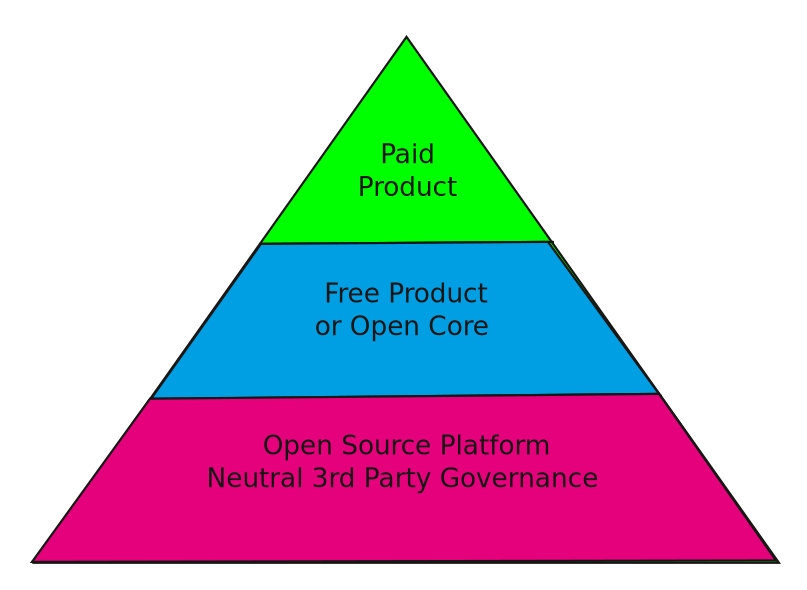
    To start down this path, I recommend that startup founders look at 3 layers of open source go to market strategy: platform ecosystem (stuff you co-develop), open core (stuff you give away but keep IP), and product focus (stuff you only allow paying customers to use). That last category, product focus, can be on-prem, cloud hosted, or SaaS services – it won’t matter, ultimately. Remember, this is about how to create compelling products that people will pay for, helping you establish a business. There are ways to use open source principles that can help you reach that goal, but proceed carefully. You can derail your product strategy by making the wrong choices.

    Foundation: the Platform Ecosystem Play

    When thinking about open source strategy, many founders thought they could release open source code and get other developers to work on their code for free as a new model of outsourcing. This almost never works as the startup founders imagined. What does end up happening is that a startup releases open source code and their target audience happily uses the code for free, often not contributing back, causing a number of startups to question why they went down the open source path to begin with. Don’t be like them.

    The way to think of this is within the concept of engineering economics. What is the most efficient means to produce the foundational parts of your software?

    • If the answer is by basing your platform on existing open source projects, then you figure out how to do that while protecting your intellectual property. This usually means focusing on communities and projects under the auspices of a neutral 3rd party, such as the Eclipse or Linux Foundation.
    • If the answer is by creating a new open source platform that you expect to attract significant interest from other technology entities, then you test product-market fit with prospective collaborators and organizations with a vested interest in your project. Note: this is a risky strategy requiring a thoughtful approach and ruthless honesty about your prospects. The most successful examples of this, such as Kubernetes, showed strong demand from the outset and their creation was a result of market pull, not a push.
    • If the answer is that you don’t need external developers contributing to your core platform, but you do need end users and data on product-market fit, then you look into either an open core approach, or you create a free product that gives the platform away for free but not necessarily under an open source license. This is usually for the cases where you need developers to use or embed your product, but you don’t need them contributing directly. This is the “innovation on the edge” approach.
    • Or, if the answer is that you’ll make better progress by going it alone, then you do that and you don’t give it a 2nd thought. The goal is to use the most efficient means to produce your platform or foundational software, not score points on hacker news.

    Many startups through the years have been tripped up by this step, misguidedly believing that their foundational software was so great that once they released it, thousands of developers would step over each other to contribute to a project.

    In the world of LLMs and generative AI, there is an additional consideration: do you absolutely need the latest models from Google, OpenAI, or elsewhere, or can you get by with slightly older models less constrained by usage restrictions? Can you use your own training and weights with off-the-shelf open source models? If you’re building a product that relies on agentic workflows, you’ll have to consider end user needs and preferences, but you’ll also have to protect yourself from downstream usage contraints, which could hit you if you reach certain thresholds of popularity. When starting out, I wholeheartedly recommend having as few constraints as possible, opting for open source models whenever possible, but also giving your end users the choice if they have existing accounts with larger providers. This is where it helps to have a platform approach that helps you address product-ecosystem fit as early as possible. If you can build momentum while architecting your platform around open source models and model orchestration tools, your would-be platform contributors will let you know that early on. Having an open source platform approach will help you guide your development in the right direction. Building your platform or product foundation around an existing open source project will be even more insightful, because that community will likely already have established AI preferences, helping make the decision for you.

    To summarize, find the ecosystem that best fits your goals and product plans and try to build your platform strategy within a community in that ecosystem, preferably on an existing project; barring that, create your own open source platform but maintain close proximity to adjacent communities and ecosystems, looking for lift from common users that will help determine platform-ecosystem fit; or build an open core platform, preferably with a set of potential users from an existing community or ecosystem who will innovate on the edge, using your APIs and interfaces; if none of those apply, build your own free-to-use proprietary platfrom but maintain a line-of-sight to platform-ecosystem fit. No matter how you choose to build or shape a platform, you will need actual users to provide lift for your overall product strategy. You can get that lift from core contributors, innovators on the edge, or adoption from your target audience, or some combination of these. How you do that depends on your needs and the expectations of your target audience.

    Up Next: open core on the edge and free products.

  • There is No Open Source Community

    There is No Open Source Community


    In January, 2006, I published this article on O’Reilly’s OnLAMP.com site, which was recently shut down. I’ve always been proud of this essay, because I think I got a lot right.  I’m republishing it now in the hopes that it will continue to educate others – and perhaps  allow others to critically evaluate where I fell short in my arguments.  The central thesis is here:

    The commoditization of software and a gradual, long-term reduction in price have played far more important roles than previously recognized. Business strategy designed to leverage open source should focus more on economies of scale (in terms of user and developer bases) and less on pleasing a mythical, monolithic community.

    Basically, stop treating open source as a social movement, because it’s not. This false assumption has caused much harm to software developers and users alike (more on that in a follow-up article). However, while I’m busy patting myself on the back for writing about software commoditization, I missed something fairly big: the value of source code itself is essentially worthless. This may have actually been more important than the price of software.

  • “Every evangelist of yesteryear is now a Community Manager ….”

    This post first appeared on Medium. It is reprinted here with permission. 

    OH: “Every evangelist of yesteryear is now a Community Manager … at least on their biz card.”

    This statement best captures a question that comes up regularly in the open source community world when you have corporations involved. Does your community manager report to engineering or marketing? It captures a number of assumptions quite nicely.

    First, the concept of a “community manager” does imply a certain amount of corporate structure regardless of whether it’s for profit or some form of non-profit. If the open source licensed project is in the wild then it probably doesn’t have the size and adoption to require people with such titles. Such well-run project communities are self-organizing. As they grow and there are more things to do than vet code and commit, they accommodate new roles. They may even form council-like sub-organizations (e.g. documentation). But for the most part, the work is in-the-small, and it’s organic. The structure of well run “pre-corporate” projects is in process discipline around such work as contributions, issue tracking, and build management.

    When projects grow and evolve to the point that companies want to get involved, using the project software in their products and services, then the project “property” needs to be protected differently. The software project already has a copyright (because it’s the law) and is covered by an open source license (because that social contract enables the collaboration), but trademarks and provenance can quickly become important. Companies have different risk profiles. A solution to such corporate concerns can be to wrap a non-profit structure around the project. This can mean the project chooses to join an existing foundation like the Apache Software Foundation or the Eclipse Foundation, or it could form its own foundation (e.g. the Gnome Foundation). In return for the perceived added overhead to the original community, it enables company employees to more actively contribute. (The code base for Apache httpd project doubled in the first few months after the ASF formed.)

    A community manager implies more administrative structure and discipline around people coordination for growth, than the necessary software construction discipline that the early project required for growth. But a foundation often brings the sort of administrative structure for events and communications such that folks in the project (or projects) still don’t have a title of “community manager.”

    Community managers are a corporate thing. And I believe they start showing up when either a project becomes a company (e.g. Apache Mesos into Mesosphere), a company wants to create a project or turn a product into a project (e.g. Hewlett Packard Enterprise with OpenSwitch), or a company wants to create a distribution of a project (e.g. Canonical with Ubuntu, Red Hat with Fedora, Cloudera with Apache Hadoop). And this is implied in the original statement about “biz cards” and questions of marketing versus engineering.

    Software companies have long understood developer networks. MSDN, the Oracle Developer Network, and the IBM Developer Network have been around for decades. They are broadcast communities carrying marketing messages to the faithful. They were run by Developer Evangelists and Developer Advocates. MVP programs were created to identify and support non-employees acting in an evangelism role. These networks are product marketing programs. They tightly control access to product engineers, who allowed to appear at conferences and encouraged to write blog posts. These networks are the antithesis of the conversation that is a high functioning open source community.

    I believe companies with long histories building developer networks (or employees that have such experience at new companies) make the mistake of thinking open source “community managers” belong in product marketing. They are probably using the wrong metrics to measure and understand (and hopefully support) their communities. They are falling into the classic trap of confusing community with customer, and project with product.

    Liberally-licensed, collaboratively-developed software projects, (i.e. open source) is an engineering economic imperative. Because of that reality, I believe the community management/enablement role belongs in engineering. If a company is enlightened enough to have a product management team that is engineering focused (not marketing focused), then the community manager fits into that team as well.

    This is a working theory for me, consistent with the successes and failures I’ve observed over the past 25 year. I would love folks feedback, sharing their experiences or expanding upon my observations.

  • How Silicon Valley Ruined Open Source Business

    Back in the early days of open source software, we were constantly looking for milestones to indicate how far we had progressed. Major vendor support: check (Oracle and IBM in 1998). An open source IPO: check (Red Hat and VA Linux in 1999). Major trade show: check (LinuxWorld in 1999). And then, of course, a venture-backed startup category: check (beginning with Cygnus, Sendmail, VA, and Red Hat in the late 90’s, followed by a slew of others, especially after the dot bomb faded after 2003). Unfortunately, VC involvement came with a hefty price. And then, of course, our first VC superstar: check (Peter Fenton).

    Remember, this was a world where CNBC pundits openly questioned how Red Hat could make money after they “gave away all their IP”. (spoiler alert: they didn’t. That’s why it’s so funny). So when venture capitalists got into the game, they started inflicting poor decisions on startup founders, mostly centered on the following conceits:

    1. OMG you’re giving away your IP. You have to hold some back! How do you expect to make money?
    2. Here’s a nice business plan I just got from my pal who’s from Wharton. He came up with this brilliant idea: we call it ‘Open Core’!”
    3. Build a community – so we can upsell them!
    4. Freeloaders are useless

    A VC’s view of open source at the time was simplistic and limited mostly to the view that a vendor should be able to recoup costs by charging for an enterprise product that takes advantage of the many stooges dumb enough to take in the free “community” product. In this view, a community is mostly a marketing ploy designed for a captive audience that had nowhere else to go. For many reasons, this is the view that the VC community embraced in the mid-2000’s. My hypothesis: when it didn’t work, it soured the relationship between investors and open source, which manifests itself in lost opportunities to this day.

    What should have been obvious from the beginning – source code is not product – has only recently begun to get airplay. Instead, we’ve been forced to endure a barrage of bad diagnoses of failures and bad advice for startup founders. It’s so bad that even our open source business heroes don’t think you can fully embrace open source if you want to make money. The following is from Mike Olson, mostly known for his business acumen with Cloudera and Sleepycat:

    The list of successful stand-alone open source vendors that emerged over that period is easy to write, because the only company on it is Red Hat. The rest have failed to scale or been swallowed.

    …The moral of that story is that it’s pretty hard to build a successful, stand-alone open source company. Notably, no support- or services-only business model has ever made the cut.

    As I have mentioned early and often, as has Stephen Walli, a project is not a product, and vice-versa, and it’s this conflation of the two that is a profound disservice to startups, developers, and yes, investors. Here’s the bottom line: you want to make money in a tech startup? Make a winning solution that offers value to customers for a price. This applies whether you’re talking about an open source, proprietary, or hybrid solution. This is hard to do, regardless of how you make the sausage. Mike Olson is a standup guy, and I hope he doesn’t take this personally, but he’s wrong. It’s not that “it’s pretty hard to build a successful, stand-alone open source company.” Rather, it’s hard to build a successful stand-alone company in *any* context. But for some reason, we notice the open source failures more than the others.

    The failures are particularly notable for how they failed, and how little has been done to diagnose what went wrong, other than “They gave away all their IP!” In the vast majority of cases, these startups were poorly received because they either a.) had a terrible product or b.) they constrained their community to the point of cutting off their own air supply. There were of course, notable exceptions. While it wasn’t my idea of the best way to do it, MySQL turned out pretty well, all things considered. The point is, don’t judge startups based on their development model; judge them on whether they have a compelling offering that customers want.

    While investors in 2017 are smarter than their 2005 cousins, they still have blinders when it comes to open source. They have distanced themselves from the open core pretenders, but in the process, they’ve also distanced themselves from potential Red Hats. Part of this is due to an overall industry trend towards *aaS and cloud-based services, but even so, any kind of emphasis on pure open source product development is strongly discouraged. If I’m a *aaS-based startup today and I approach an investor, I’m not going to lead off with, “and we’re pushing all of our code that runs our internal services to a publicly-accessible GitHub account!” Unless, of course, I wanted to see ghastly reactions.

    This seems like a missed opportunity: if ever there was a time to safely engage in open source development models while still maintaining your product development speed and agility, using a *aaS model is a great way to do it. After all, winning at *aaS means winning at superior operations and uptime, which has zilch to do with source code. And yet, we’re seeing the opposite: most of the startups that do full open source development are the ones that release a “physical software download” and the SaaS startups run away scared, despite the leverage that a SaaS play could have if they were to go full-throttle in open source development.

    It’s gotten to the point that when I advise startups, I tell them not to emphasize their open source development, unless they’re specifically asked about it. Why bother? They’re just going to be subjected to a few variations on the theme of “but how are you going to get paid?” Better to focus on your solution, how it wins against the competition, and how customers are falling over themselves to get it. Perhaps that’s how it always should have been, but it strikes me as odd that your choice of development model, which is indirectly and tangentially related to how you move product, should be such a determining factor on whether your startup gets funded, even more so than whether you have a potentially winning solution. It’s almost as if there’s an “open source tax” that investors factor into any funding decision involving open source. As in, “sure, that’s a nice product, but ooooh, I have to factor in the ‘open source tax’ I’ll have to pay because I can’t get maximum extraction of revenue.”

    There are, of course, notable exceptions. I can think of a few venture-backed startups with an open source focus. But often the simple case is ignored in favor of some more complex scheme with less of a chance for success. Red Hat has a very simple sales model: leverage its brand and sell subscriptions to its software products. The end. Now compare that to how some startups today position their products and try to sell solutions. It seems, at least from afar, overly complicated. I suspect this is because, as part of their funding terms, they’re trying to overcome their investors’ perceptions of the open source tax. Sure, you can try to build the world’s greatest software supply house and delivery mechanism, capitalizing on every layer of tooling built on top of the base platform. Or you can, you know, sell subscriptions to your certified platform. One is a home run attempt. The other is a base hit. Guess which way investors have pushed?

  • Ask Not What Your Community Can Do For You

    This post first appeared on Medium. It is reprinted here with permission. 

    During his inaugural speech on Jan. 20, 1961, U.S. President John F. Kennedy uttered the challenge, “And so, my fellow Americans: ask not what your country can do for you — ask what you can do for your country.” Its simple meaning was to challenge society to contribute to improve the public good. But I think there’s a bigger message here, and that is that we have to work together as a society to improve our collective state. And because of that, I think the statement has a lot to tell us about community building in general and for open source communities certainly.

    Publishing software with an open source license is the definitive step of creating an open source project. The creation of such collaborative licensing is Richard Stallman’s brilliant hack on the system of copyright law back in the early 1980s. If software is covered by copyright, so a user of the software must honor the copyright by adhering to its license or otherwise asking for permission, then create licenses that say, “do whatever you will with this software, while honoring these clauses in return.” It is the perfect hack on a software copyright system that would otherwise collapse under its own weight when the dynamic nature of software encountered the friction-free publishing channel of the Internet. But while publishing software this way is the definitive step of creating an open source project, it doesn’t create a community.

    While many societal norms and interactions are imposed by a choice of where you live, from the country down to your street address, on the Internet those choices and interactions play out differently. The cost of choosing your online community is far lower in the digital world than the economic friction in the world of bricks and mortar. So is the cost of leaving. As an online community you need to attract folks differently if they’re going to engage. You need to make it easy for the community to do the things they want to do. They aren’t coming to help you build your community, at least not at first. They’re coming because the project (the neighborhood) is interesting to their own needs and goals.

    And there are three sorts of folks that join your community.

    • There are the folks that just want to live there using your software.
    • There are the folks living there that are happy to help in small ways, letting you know where the potholes that they almost hit every day are forming, or about a vacant lot that’s unsafe.
    • And there are the folks living there, that let you know about that vacant lot, and that are happy to help clean it up, contribute a park bench, or organize the neighborhood party to celebrate after the cleanup is done.

    And you need to make it easy in three different ways for those three sorts of folks in your community, because the groups are nested inside one another. People don’t build parks in vacant lots where they don’t live. They’re very unlikely to notice the potholes in a meaningful way if they don’t live on the street. They won’t move into your neighborhood in the first place if its cluttered, unorganized, and doesn’t provide any guidance for where the schools and shops are, or when garbage collection happens and how recycling works there. And they certainly don’t move into neighborhoods in which they can’t afford the costs (in time or money).

    Growing and scaling a successful open source software project requires building three on-ramps: first for users, then for developers, and ultimately for contributors.

    If it is not blindingly easy to download the software, install it to a known state, and use it in some meaningful way, you will not encourage a growing set of neighbors. If the developers in that group of neighbors can’t easily build the software to a known state so they can effect their own changes, then they will look elsewhere for easier to use solutions. They will move out and move on. If you don’t make it easy to contribute those developers’s changes back to the project, it becomes a permanent growing collection of expensive forks that doesn’t harden the way good software projects do.

    In the 1990s, we had a ten-minute rule of thumb for packaged PC software from pulling the shrink-wrap off the box to doing something meaningful. When you download an app to your phone, how long do you work at it until it behaves as advertised or you abandon it? The same sort of thinking needs to apply to your software project users. So to for the developers in that group of users that will want to do things with the project to their own needs. So to for your eventual contributors out of that group of developers.

    Well run successful open source software communities make the costs of using, developing, and contributing to the community easy to bear, and they work to continue to make it easier. Publishing a piece of software on the Internet with an open source license is easy. Growing a community takes work, but the value in the hardened, evolved software for all is easy to see in successful communities. So ask not what your community can do for you, ask what you can do for your community.

  • There is NO Open Source Business Model

    Note: the following was first published on medium.com by Stephen Walli. It is reprinted here with his permission.

    Preface: It has been brought to my attention by friends and trusted advisors that a valid interpretation of my point below is that open source is ultimately about “grubby commercialism”, and altruism equals naïveté. That was not my intent. I believe that economics is about behaviour not money. I believe in Drucker (a company exists to create a market for the solution), not Friedman (a company exists to provide a return to shareholders). I believe in the Generous Man. I believe in Rappaport’s solution to the Prisoner’s Dilemma to always start with the most generous choice. I believe we’ve known how communities work since you had a campfire and I wanted to sit beside it. I had the pleasure of watching Bob Young give a talk today at “All Things Open” where he reiterated that a successful company always focuses on the success of its customers. I think that was stamped on Red Hat’s DNA from its founding, and continues to contribute to its success with customers today. I believe sharing good software is the only way to make all of us as successful as we can be as a tribe. I believe there is no scale in software without discipline.

    The open source definition is almost 20 years old. Red Hat at 22 is a $2B company. MySQL and JBoss have had great acquisition exits. Cloudera and Hortonworks are well on their way to becoming the next billion dollar software companies. But I would like to observe that despite these successes, there is no open source business model.

    yosuke muroya (on Flickr)

    I completely believe in the economic value of liberally-licensed collaboratively-developed software. We’ve shared software since we’ve developed software, all the way back into the late 40s and early 50s. This is because writing good software is inherently hard work. We’ve demonstrated that software reviews find more bugs than testing, so building a software development culture of review creates better software. Much of the invention in software engineering and programming systems has been directed towards re-use and writing more and better software in fewer lines of code. Software can’t scale without discipline and rigour in how it’s built and deployed. Software is inherently dynamic, and this dynamism has become clear in an Internet connected world. Well-run, disciplined, liberally-licensed collaborative communities seem to solve for these attributes of software and its development better than other ways of developing, evolving, and maintaining it. There is an engineering economic imperative behind open source software.

    Here’s an example using open source that I believe closely demonstrates that reality.

    Interix was a product in the late 90s that provided the UNIX face on Windows NT. It encompassed ~300 software packages covered by 25 licenses, plus a derivative of the Microsoft POSIX subsystem, plus our own code. This was before the open source definition. We started with the 4.4BSD-Lite distro because that’s what the AT&T/USL lawyers said we could use. The gcc compiler suite would provide critical support for our tool chain as well as an SDK to enable customers to port their UNIX application base to Windows NT.

    It took a senior compiler developer on the order of 6–8 months to port gcc into the Interix environment. It was a little more work when you include testing and integration, etc., so round it up to on the order of $100K. The gcc suite was about 750K lines of code in those days, which the COCOMO calculation suggests was worth $10M-$20M worth of value depending on how much folks were earning. So that’s roughly two orders of magnitude in cost savings instead of writing a compiler suite on our own. That and this was a well-maintained, robust, hardened compiler suite, not a new creation created from scratch in a vacuum. That is the benefit of using open source. You can see a similar net return on the 10% year-on-year investment Red Hat makes on their Linux kernel contributions as they deliver Fedora and RHEL. Of course with Interix, we were now living on a fork. This means we are drifting further away from the functionality and fixes on the mainline.

    The back of the envelop estimate suggested that every new major revision of gcc would cost us another 6+ months to re-integrate, but if we could get our changes contributed back into the mainline code base, we were probably looking at a month of integration testing instead. So from ~$100K we’re approaching $10K-$20K so possibly another order of magnitude cheaper by not living on a fork. We approached Cygnus Solutions as they were the premier gcc engineering team with several gcc committers. The price to integrate quoted to us was ~$120K, but they were successfully oversubscribed with enough other gcc work that they couldn’t begin for 14 months. Ada Core Technologies on the other hand would only charge ~$40K and could begin the following month. It was a very easy decision. (We were not in a position to participate directly in the five communities hiding under the gcc umbrella. While some projects respected the quality of engineering we were trying to contribute, others were hostile to the fact we were working on that Microsoft s***. There’s no pleasing some people.)

    This wasn’t contributing back out of altruism. It was engineering economics. It was the right thing to do, and contributed back to the hardening of the compiler suite we were using ourselves. It was what makes well run open source projects work. I would argue that individuals make similar decisions because having your name on key contribution streams in the open source world is some of the best advertising and resume content you can provide as a developer on your ability to get work done, in a collaborative engineering setting, and demonstrating you well understand a technology base. It’s the fact with which you can lead in an interview. And it’s fun. It’s interesting and challenging in all the right ways. If you’re a good developer or interested in improving your skills, why wouldn’t you participate and increase your own value and skills?

    Well run open source software communities are interesting buckets of technology. If they evolve to a particular size they become ecosystems of products, services (support, consulting, training), books and other related-content. To use an organic model, open source is trees, out of which people create lumber, out of which they build a myriad of other products.

    Red Hat is presented as the epitome of an open source company. When I look at Red Hat, I don’t see an open source company. I see a software company that has had three CEOs making critical business decisions in three different market contexts as they grow a company focused on their customers. Bob Young founded a company building a Linux distro in the early days of Linux. He was focused on the Heinz ketchup model of branding. When you thought “Linux”, Bob wanted the next words in your head to be “Red Hat.” And this was the initial growth of Red Hat Linux in the early days of the Internet and through the building of the Internet bubble. It was all about brand management. Red Hat successfully took key rounds of funding, and successfully went public in 1999. The Red Hat stock boomed.

    Matt Szulick took over the reins as CEO that Fall. Within a couple of years the Internet bubble burst and the stock tumbled from ~$140 down to $3.50. Over the next couple of years, Red Hat successfully made the pivot to server. RHEL was born. Soon after Fedora was delivered such that a Red Hat focused developer community would have an active place to collaborate while Red Hat maintained stability for enterprise customers on RHEL. They successfully crossed Moore’s Chasm in financial services. JBoss was acquired for $350M to provide enterprise middleware. Red Hat went after the UNIX ISV community before the other Linux distro vendors realized it was a race.

    In 2008, Jim Whitehurst took over the helm. In Whitehurst, they had a successful executive that had navigated running an airline through its Chapter 11 restructuring. So he knows how to grow and maintain employee morale, while managing costs, and keeping customers happy in the viciously competitive cutthroat market of a commercial air travel. He arrives at Red Hat just in time for the economic collapse of 2008. Perfect. But he has also led them through steady stock growth since joining.

    Through its history, Red Hat has remained focused on solving their customers problems. Harvard economist Theodore Levitt once observed that a customer didn’t want a quarter inch drill, what they wanted was a quarter inch hole. While lots of competing Linux distro companies tried to be the best Linux distro, Red Hat carefully positioned themselves not as the best Linux but as an enterprise quality, inexpensive alternative to Solaris on expensive SPARC machines in the data centre.

    Red Hat certainly uses open source buckets of technology to shape their products and services, but it’s not a different business model from the creation of DEC Ultrix or Sun SunOS out of the BSD world, or the collaborative creation of OSF/1 and the evolution of DEC Ultrix and IBM AIX, or the evolution of SunOS to Solaris from a licensed System V base. At what point did Windows NT cease to be a Microsoft product with the addition of thousands of third party licensed pieces of software including the Berkeley sockets technology?

    When companies share their own source code out of which they build their products and services, and attempt to develop their own collaborative communities, they gain different benefits. Their technology becomes stickier with customers and potential future customers. They gain advocates and experts. It builds inertia around the technology. The technology is hardened. Depending on the relationship between the bucket of technology and their products, they can evolve strong complements to their core offerings.

    The engineering economic effects may not be as great as pulling from a well run external bucket of technology, but the other developer effects make up for the investment in a controlled and owned community. It’s why companies like IBM, Intel, Microsoft, and Oracle all invest heavily in their developer networks regardless of the fact these historically had nothing to do with open source licensing. It creates stickiness. Red Hat gains different benefits from their engineering investments in Linux, their development of the Fedora community, and the acquisition of the JBoss technology, experts, and customers.

    I believe open source licensed, disciplined, collaborative development communities will prove to be the best software development and maintenance methodology over the long term. It’s created a myriad of robust adaptive building blocks that have become central to modern life in a world that runs on software. But folks should never confuse the creation of those building blocks with the underlying business of solving customer problems in a marketplace. There is no “open source business model.”