When I’ve written about the inevitable march of Open Source, there are a couple of things I’ve failed to note, or that I just got wrong. One of those is that I conflated the issues of open technology trends with Open Source. While both are trending upwards, they are certainly not the same. The central premise that I’ve advanced before still holds – that is, the internet has led to unprecedented downward price pressure on software, thanks to a market flooded with software and software developers, with the added bonus that they can all collaborate with each other in “real time.” This serves to accelerate the development of software, creating a vast, fast-moving pipeline of new features over a broad swath of software markets. As opposed to traditional software feature pipelines, this one is almost self-correcting in that the users, developers and user-developers are in constant contact with one another, adjusting the pipeline as it moves along. This part is boring. At the risk of patting myself on the back too much, my assertion has been proven correct many times over.
No, where I got it wrong was in equating open technology and the trends in that direction with Open Source, as defined by the OSI. Sure, this downward price pressure makes the current open source ecosystem viable, but that’s not nearly the same as saying that trends towards openness will necessarily result in an Open Source end. The truth is, there is a wide range of points on the open spectrum. As it stands, I’ve written a great deal about “macro” open trends, but not much about what happens on the “micro” level. With this post, I’ll kick off an attempt to do that.
One point on the open spectrum represents the ideal of Free Software, governed by an overt moral ethos, whereby all players are expected to share alike as a means of building a better technology world. At another point lies Open Source, as defined by the OSI, which is kinda-sorta governed by the same moral ethos as Free Software, but they don’t really like to talk about it much, for fear of chasing away the very companies they’re trying to attract. And at many other points on the open spectrum lie all sorts of technologies that are neither Free Software or Open Source – even if they have adopted a licensing scheme endorsed by both.
These other non-Open Source and non-Free Software technologies develop a degree of openness for all sorts of competitive reasons. Witness, for example, how Microsoft is attacking the RIT market or web services. In both cases, they have had to be open in order to stay competitive. While Microsoft may end up using an Open Source license in some cases, they often do not, but they still want some of the benefits of openness without giving up too much control. In these cases, Microsoft clearly wants to grease the skids of adoption and lower barriers to entry. There are also startups that wish to tap into open trends, with some coming under fire for using the term “Open Source” without using an OSI-compliant license. While they shouldn’t use the term Open Source without conforming to the Open Source Definition, they should at least define their work in such a way that differentiates them from traditional enterprise software plays.
Trends vs. Personal Experience
It’s one thing to say that the overall trends favor more open technology and Open Source, but what about on an individual level? What do these trends say about individual projects and their chances of success? The answer, it turns out, is not much. All the open trends in the world won’t save a bad project. At this level, it’s really all about emotional attachment, warm fuzzies, dynamics of the project leadership, and any number of other factors that lead to more people gravitating to community X over community Y. It is within this “micro” sphere that factors such as project personality, license choice, degree of openness, and yes, project ethics come into play.
It is at this level that community leaders will have to consider the audience they want to attract. Does your desired audience often seem paranoid and overly cynical? You’ll have to work extra hard to woo them, and you’ll probably need to start with the GPL or even a BSD license. That’s not the final step, however. To truly give them warm fuzzies, you’ll have to consider their cultural priorities. Will they naturally gravitate towards organizations like the Electronic Frontier Foundation or the Free Software Foundation? If so, you should probably at least consider some form of relationship with them. Making statements about their pet issues wouldn’t hurt either – the OOXML debacle presents a great opportunity, as does the recent controversy over what Open Source means. Opining on the tactics of the RIAA and MPAA might help, as well. Of course, these are only suggestions for a certain audience – the ones with laptop stickers that say “corporate websites suck”.
I wish I could calculate how much it’s worth for a company or project to engage in this sort of cultural activity, but I really can’t. It most likely won’t help with the enterprise IT buyer, although it’s good to remember that they are people, too. Regardless, it’s a good rule of thumb that when you’re trying to attract an audience, it’s good to know what things they care about the most. As has often been noted, it’s not enough to open your code and throw it over the wall. I would add that it’s also not good enough to woo the audience with just technology – there has to be some force of personality and a willingness to participate in some cultural issues.
Blog
-
Announcing: Ubucon Germany
Ich liebe Deutschland… and I’m very excited to pass on some news regarding the latest announced Ubucon, which will take place in Germany. Specifically, it will be at the Hochschule Niederrhein in Krefeld, Germany, and it takes place on October 20 and 21. For further info, see these links:Ubucon Germany Home – register hereUbuntu.com wiki page – includes links to brainstorming sessionsBlog post (in English) on the Ubucon GermanyAnnouncement on the Ubuntu FridgeAnd of course, what would a Ubucon be without…#ubucon-de – IRC channel on freenode.netEdit: Oops – I corrected the IRC channel. I had erroneously listed it as #ubucon -
Futbol Hating: a HOWTO
It’s hard work being a sportswriter these days. You spend your entire life living in fear of something, and you bash it at every turn as you clutch to the hope that your worst fears will never come true… and then it happens. Bit by bit, drip by drip, one gringo at a time, your worst fears begin to come true. At first, gringo futbol was non-existent. And then that idiot Pele came around here, and folks just had to flap their gums about how futbol was the future, how it would eventually eclipse all other sports, including gridiron football. As a hater, you were briefly relieved when Pele went away, with the rest of those gum-flapping gringos following soon after.
But then we had a World Cup – “it’s just a one-time event!” you screamed. And then a new league started – “Americans won’t watch soccer week after week.” And you thought they were on the ropes when teams started folding and moving around – “aha, I told you so! I told all of you!” But they’re still here. And the gringo team has improved by leaps and bounds – “They’re just a flash in the pan! See? They flamed out in Germany!” And yet, the gringo team is the king of Norte America. And just when you thought it was safe to walk around in your Jim Rome bubble, along comes becks-mania. It’s hard work being a hater.
So for all you haters, I wanted to lend a helping hand, because you must be in a world of hurt. Because, after all, the thing you despised the most and couldn’t fathom – that the gringos would, in fact, get it together and support futbol – is here. That futbol has been succeeding the entire time, spreading from one gringo to another, right under your nose, with nary a hint on your beloved sportscenter – dah de da, dah de da! And now, even that isn’t safe. So without further Adu (sorry, kittie!), here’s a template for your next futbol-hating article and a day-to-day guide to surviving la nueva orden del futbol:- Never give up. Never ever give up. Repeat to yourself and to your frightened audience, “There is no futbol here. Do you see any futbol here? I don’t see any futbol here. Beckham is here for movies. Only foreigners watch soccer.” There, doesn’t that feel better?
- SAY IT REALLY LOUDLY – If number 1 above doesn’t work, surely that just means you need to yell it more loudly. Yelling something over and over again definitely makes it more true, because it shows the depth to which you feel it is true. And if you really really really wish it to be true, and wish upon a star, and yell it a little more loudly, it will come true! Uncle Disney wouldn’t lie to you.
- Remember, futbol sucks – It doesn’t hurt to remind yourself and your audience of just how badly futbol stinks. Hello, 0 – 0? Puh-leeze! Occasionally, you might find your audience beginning to succumb to the futbol siren song, so you may want to add the occasional barbs about slow play, the best ath-a-letes never play futbol, most soccer players (and fans) are gay, and never shy away from your ace in the hole: diving Latinos who writhe in pain at the slightest contact
- History repeats itself – Nothing has changed since all those other crappy futbol efforts failed. History repeats itself, and those that fail to remember history are doomed to repeat it. If only the gringos would just listen to you! Remind your audience how smart they are by understanding history… even if they need to be reminded of particular events.
- You really really really don’t care – In fact, you care so little and couldn’t care less, that you’re prepared to write multiple articles about the exact depths to which you really really really don’t care. And if that doesn’t work, see points #1 and #2 above: shout to everyone within earshot ABOUT HOW MUCH YOU JUST DON’T CARE. Repeat.
- If it happened en espanol, it never actually happened – the logic is brilliant. You may have been reminded by some gringos about some futbol event with tens of thousands of fanaticos in attendance. However, it’s a well-known fact that highly attended futbol events are composed of a mostly Spanish-speaking audience. Therefore, the audience could not have been an English-speaking majority. Ergo, an insignificant number of people care enough to drive up ticket prices, thus rendering it completely irrelevant to your audience. In fact, you might even say that it never actually happened. In fact, there’s no point in even mentioning it to your audience, due to its insignificance and complete irrelevance. After all, you wouldn’t want them to come to the wrong conclusion. *Whew* you’re safe!
- There are no futbol supporters – You may on occasion receive correspondence from some gringo idiots who take issue with your well-reasoned, articulate arguments. Just remember, they’re all written by the same person. Every single one of them. There’s this one guy in Utah who writes every single futbol-supporting letter in existence. Scout’s honor.
- Never give up. Never ever give up. Repeat to yourself and to your frightened audience, “There is no futbol here. Do you see any futbol here? I don’t see any futbol here. Beckham is here for movies. Only foreigners watch soccer.” There, doesn’t that feel better?
-
“estrella del equipo gringo”
It all started with this image blasted across Univision after the USA beat Mexico 2-1 to win the Gold Cup: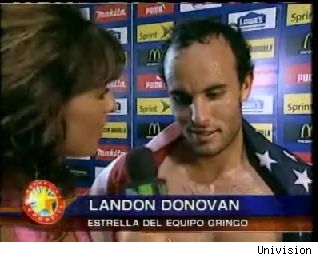
And then it occurred to me – we *are* the gringos. We are the other, the unrecognized. Even among soccer fans in the US, we are a distinct minority, a subset of an overall despised minority. We don’t worship international players in foreign leagues. We don’t follow the family’s historical teams in the old country. We are fans of the American team, the gringo team. And when the gringo team plays in our own country, we are still outnumbered, a loud, vocal minority among the passionate ex-pats from other countries. We are derided by the futbol-ignorant mainstream, and we are discounted by those fans who feel the gringo team is beneath them.
There are those who chafe at the term gringo, but I say wear the gringo badge with pride. Embrace it:Yo soy un gringo! Yo soy un fanatico del equipo gringo!
And the next time you are disrespected either by those who fear futbol or those who feel their futbol is above yours, just remember, not everyone can be un fanatico del equipo gringo. -
Hair be Gone!
I did it –
-
InfoWorld Features Hyperic – part of Month of Enterprise Startups
InfoWorld Senior Editor Paul Roberts gets the skinny on Hyperic, from purchasing the technology for a buck, to landing 250 paying customers and securing OEM deals with MySQL and JBoss. A great read.
read more | digg story -
Mark Leno Rebuts Microsoft
Mark Leno responds to Microsoft’s lobbyists in this hearing on April 17, 2007. Mark Leno introduced AB 1668, California’s open file formats bill.
-
Bonnie Garcia – Enter the FUD Brigade
In opposing California AB 1668, Bonnie spreads a heaping helping of fear, uncertainty and doubt by discussing wholly unrelated IT projects that failed. Taken from April 17, 2007 hearing. (support www.bytesfree.org
-
More Microsoft Opposition to California AB 1668
Here’s a bit of Q & A between committee members and Microsoft’s lobbyists at the April 17th hearing before the Committee on Jobs, Economic Development, and the Economy. Unfortunately, many committee members are not that familiar with the subject matter. (video from calchannel.com – support www.bytesfree.org
-
Microsoft Lobbies Against California AB 1668
See Microsoft strenuously argue against California AB 1668, a bill that would mandate open formats for state government. This hearing took place before the Committee on Jobs, Economic Development, and the Economy on April 17, 2007. (video from The California Channel – www.calchannel.com – support www.bytesfree.org )


